



Duel Autocare
Utility Dual-Sided Microfibre Cloth
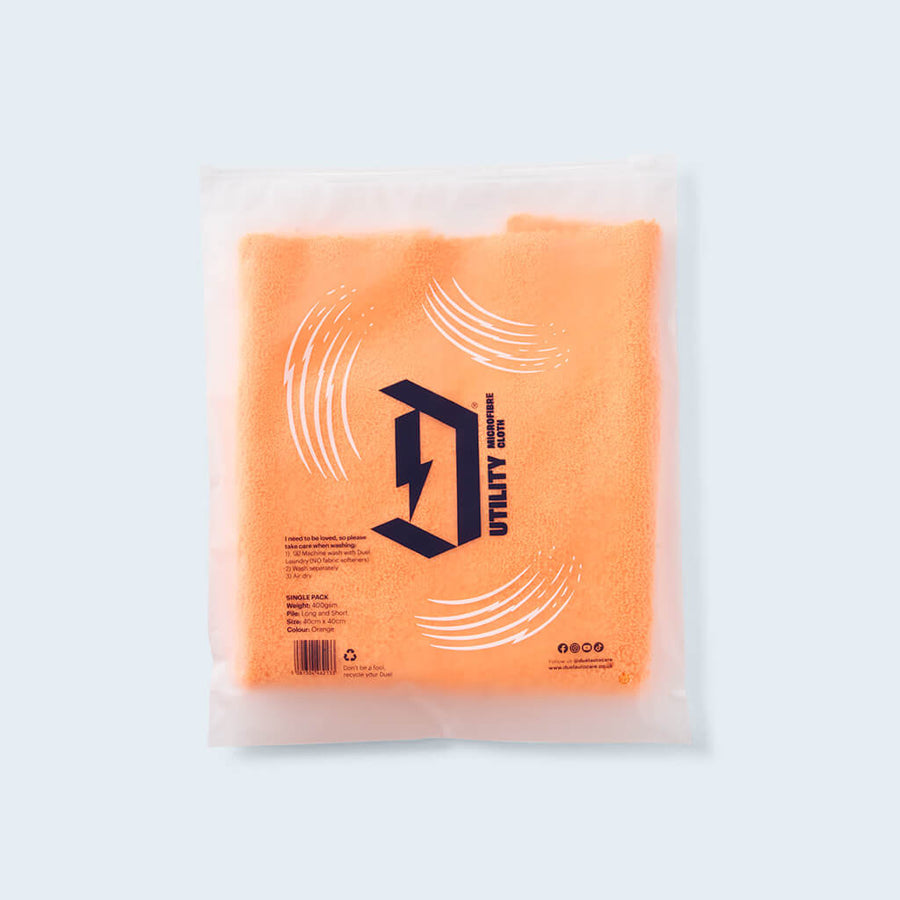
The Utility is the cloth that does both halves of the job. One face is short pile, for spreading a product on or taking it back off. The other is plush, for buffing down to a clean, streak-free finish. So a job like Oxide or Element that would normally take two cloths takes one, and you flip rather than reach. Edgeless, 40 x 40cm, and in orange or green so you can colour-code it to a job.
At A Glance
Why You'll Love It
A plush face for buffing and a short pile face for spreading or removing. Most detailing jobs need both, and this saves you putting one cloth down to pick another up mid-panel.
Spray Oxide on, spread it with the short side, flip, buff with the plush side. Same with a cured wax. One cloth, one pass, no swapping.
No stitched border and no tag. The most common cause of a cloth marking paint is its own edge being dragged across it, and there isn't one here.
Orange and green so you can assign a colour to a job and keep it that way. Keeping the cloth that touches wax separate from the one that touches trim is how you stop cross-contamination.
What Does A Dual-Sided Cloth Actually Do?
Most detailing products need two actions rather than one. You put something on, you take it back off. A quick detailer needs spreading and then buffing. A wax needs curing and then removing and then finishing. Each of those is really two different jobs asking for two different surfaces.
A short pile face has less fibre standing up off the base cloth, so it grips. That is what you want when you are moving product around, breaking a cured wax off the surface, or picking up residue — it makes contact and it takes material with it. A plush face is the opposite: long, soft fibre with a lot of air in it, which glides rather than grips and lifts whatever is left into the pile. That is what leaves a panel clear rather than smeared.
The Utility puts one of each on the same cloth. You stop needing to work out which cloth in the pile is which, and you stop the very common mistake of trying to buff a finish off with a cloth that has already picked up a load of product. Flip it, and the face touching the paint is clean and doing a different job.
"Nearly every product you own needs putting on and taking off. The Utility is one cloth that does both halves properly, instead of two that each do one."
— Duel AutocareIs It Right For You?
- Applying and buffing quick detailers, spray sealants and hybrid detailers
- Removing cured wax and finishing to a clean gloss
- Anyone who wants fewer cloths in the kit doing more of the work
- Colour-coding a kit by job
- Beginners who don't yet want a drawer full of specialist cloths
- You need to dry a car — that's a volume-of-water job and wants the Triple Twisted Loop drying towel
- You want the softest possible cloth for a final wax buff on dark paint — the Coral Fleece is plusher on both faces
- You're cleaning glass — use the Ultra-Fine Glass Cloth, which is a flat weave built not to smear
- You need something for wheels, arches or engine bays — use a General Purpose cloth and keep it away from paint
- All paint types and colours
- Ceramic coatings, waxes and sealants
- Glass
- Interior plastics, vinyl and trim
- Vinyl wrap
- Wheels, arches and engine bays — brake dust embeds and does not fully wash out
- Any cloth that has been on the floor
- Fabric softener and dryer sheets
- Tumble drying
How To Use The Utility Cloth
No pre-wash needed. Take it out, fold it into quarters so you have eight usable faces, and it's ready to go. Keep track of which way up it is — short pile one side, plush the other.
Mist your product onto the panel, or onto the short pile face if you'd rather control the amount. Spread it evenly with light pressure. This face grips, so it moves product around rather than soaking it straight up.
Follow what the product asks for. A quick detailer needs no dwell. A wax needs to cure before you touch it. Buffing a product that isn't ready is what causes streaking — don't rush this step.
Turn the cloth over and buff lightly in straight passes. The plush face glides and lifts residue into the pile instead of pushing it around, which is what gives you a clear finish rather than a hazy one.
When a face loads up with product, refold to a clean one. When all eight faces are done, shake the cloth out and hang it to air. Wash it with Duel Laundry when it starts to smear rather than buff cleanly, or when it's visibly carrying residue.
Which Side Does What?
| Side | What it does | Use it for |
|---|---|---|
| Short pile | Grips the surface, moves product around, picks residue up | Spreading a quick detailer or sealant · removing cured wax · lifting interior dressing · general wipe-down |
| Plush | Glides over the surface and lifts residue up into the pile | Final buff to a clear finish · removing the last of a detailer · anything where a smear-free result matters |
The rule is simple — the side that grips goes on first, the side that glides goes on last. If a finish looks hazy rather than clear, you almost certainly buffed with the short pile side instead of flipping.
The Products The Utility Is Built Around
Frequently Asked Questions
What is a dual-sided microfibre cloth for?
Which side do I use first?
Are microfibre cloths lint free?
What does edgeless mean, and does it matter?
How do I wash it?
Which colour should I choose?
Care Instructions
 Wash 30°C
 No Bleach
 No Tumble Dry
 No Iron
 No Dry Clean
 No Softener
Not classified as hazardous. No SDS required for textile products.
- Machine wash at 30°C with Duel Laundry microfibre wash detergent
- Do not use fabric softener or dryer sheets
- Wash separately from other fabrics
- Air dry — do not tumble dry
- Do not bleach · Do not iron · Do not dry clean
Technical Specification
| Product type | Microfibre Cloth |
| Construction | Dual-sided — plush face and short pile face |
| Size | 40cm × 40cm |
| Edge | Edgeless |
| Pile weight | 400 GSM |
| Fibre blend | 80% polyester · 20% polyamide |
| Colours | Orange · Green |
| Suitable for | Paintwork, glass, interior trim, ceramic coatings and vinyl wrap |
| Supplied | Single pack |
| Wash | 30°C with microfibre detergent · no fabric softener · wash separately · air dry · no tumble dry, bleach, iron or dry clean |